
By Dr. Sriparna Pathak
Published on October 10, 2024
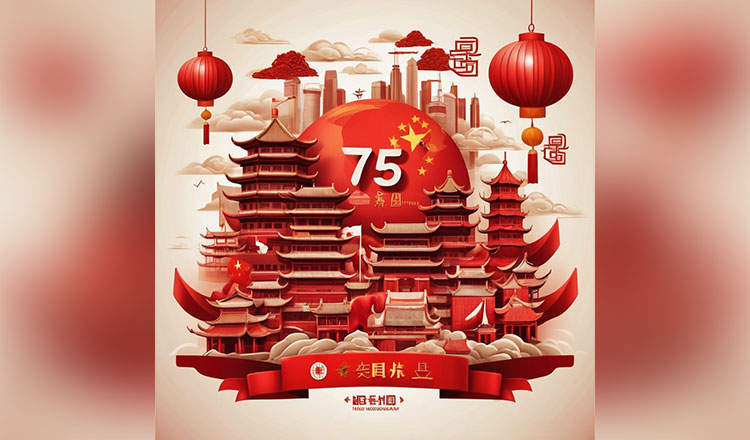
On October 1, 1949, Chairman Mao Zedong stood at the Tiananmen Square and proclaimed the founding of the People’s Republic of China (PRC). The new national anthem, the ‘March of the Volunteers’ was played and the new national flag of the PRC was officially unveiled to the newly founded state and hoisted for the first time as a 21 gun-salute was fired in the distance. Since then, 75 years on, the PRC has become one of the two most powerful states of the international system and is known as the manufacturing platform of the world. China’s economic footprints are evident across the world, its military capabilities are growing rapidly and its diplomatic influence even if disliked in many cases, cannot be ignored. However, things were very different in 1949. The country was still reeling from the aftermath of the Chinese Civil war, and the industrial output value had dropped by 50% from its peak, before the founding of the PRC. Heavy industry had taken a huge hit, decreasing by 70%, while light industry had decreased by 30%. Key sectors like coal, steel, grain and cotton all suffered greatly with declines of 48%, over 80%, about 25%, and 48% respectively. The Chinese Communist Party (CCP) began implementing policies aimed at rebuilding and consolidating the economy, which eventually led to a period of relative rapid development.
75 years on, the PRC shares eerie similarities with the epoch of history that begun in 1959 and roughly lasted till Deng Xiaoping begun his program of reforms and opening up. Currently, the PRC and Russia are in a “no limits” friendship, just the way it had in 1949 chose to lean to the side of the Soviet Union. Economic growth rates have come crumbling owing to China’s own domestic economic policies’ mismatch with prevailing realities, and just the way Mao Zedong believed in “politics in command”, Xi Jinping through his myriad policies, including crack downs on tech giants, believes in political control over economic freedoms. Even though the Chinese economy was in shambles when the CCP and Mao Zedong took control, Chinese foreign policy was aggressive. In the early 1950s itself, Mao had stated that the “East wind prevails over the West wind”, implying that socialism would prevail over capitalism. He and the PRC had taken an overtly belligerent stance against the West even back then, and the PRC immediately after its creation jumped into the Korean War. There was even one time when both the US and the USSR looked at the PRC with suspicion and the Soviet Union in 1969, during its border dispute with the PRC had even considered the nuclear option! The PRC also went in for the Vietnam War, in addition to the myriads of conflicts it had with India in the 1950s, 1962, 1967 and so on. This was over and above the first and second Taiwan Straits crisis. All of these and many more have eerie similarities with the PRC under Xi Jinping, who has clearly done away with Deng Xiaoping’s dictum of hiding one’s power and biding one’s time.
The question that arises here is whether or not there is a continuity in the ways in which China sees itself and the world. In terms of colonialism, there has never been a change in which China sees historical wrongs. The official positions of the PRC under various leaders ranging from Mao to Deng to Hu to Xi have all remained against imperialism and colonialism. History has always shaped the PRC’s views of the world and have been weaved into its foreign policy postures. This is even more evident under Xi Jinping who, like Mao makes bold proclamations against the West. The PRC under Mao also saw itself as a leader and one of the major reasons for the Sino-Soviet split was due to Mao’s interpretations of socialism and his desire to lead the communist bloc. One can see similarities under Xi, who through the creation of alternative models of governance, be it in the form of the Belt and Road initiative or the Asian Development Bank or the Shanghai Cooperation Organization, or the grouping of Brazil, Russia, India, China and South Africa (BRICS) seeks to highlight the PRC’s role as a leader. Xi had in fact, in his 19th Party Congress speech in 2017 stated that developing countries should follow China’s model of economic governance. China has often lamented the loss of its position and repute as the Middle Kingdom, and it is visible in foreign policy formulations in every epoch of history. It has only increased under Xi, wherein concepts of ‘tianxia’ have become only more pronounced. Tianxia is a Chinese concept which translated to “all under heaven” and ranges from political meanings like a vision for the world system to more subjective meanings like a way to represent the aspirations of the people.
For the West and the rest, the PRC in 1949 emerged as a challenger to the existing world order and continues to remain so. The West had once imagined, much to its dismay later on that the PRC would eventually democratise and become a part of the liberal international order. The West, led by the US facilitated the entry of the PRC into several institutions, including the World Trade Organization (WTO). However, Beijing only leveraged these facilitations to its own use. The PRC wants a return to its stature of the Middle Kingdom and there is a continuity in the ways in which it sees the world. Tools and mechanisms change in different historical time periods, but the core goals remain the same.
The Author is an Associate Professor of China Studies at the School of International Affairs, at O.P. Jindal Global University. She is also the Director of the Centre for Northeast Asian Studies at the University.
Disclaimer: The Views expressed in the Article are of the Author.
Image Credits: Dan Steinbock / China Daily

KIIPS is a premiere think-tank that intends to provide a platform to academics, researchers, scholars and experts from across the country and abroad.