
By Shayoni Sengupta
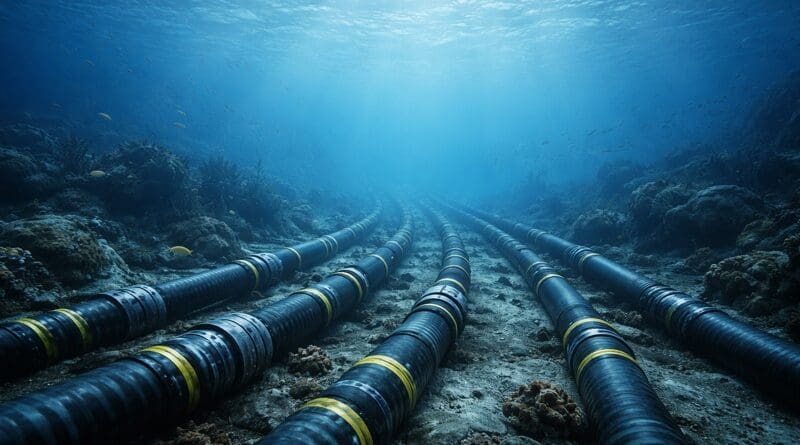
The geopolitics of the Indo-Pacific region has long been dominated by great-power strategic rivalries, maritime disputes, and debates over vital sea lanes. But there is another set of maritime infrastructure shaping regional affairs. The vast majority of international data transits the region via submarine communications cables, making them a linchpin of global connectivity and the lifeline for financial, governmental, and commercial activity. Physical interruptions to this system could cause severe disruptions to international and local business, not to mention social and political unrest. The problem has become particularly pertinent to the geopolitics of the region as digital networks become ever more deeply embedded in society. The reason is not just that natural events such as earthquakes and volcanic activity can sever undersea cables or that fishing and shipping traffic can damage them. The disruptions to connectivity and communications caused by interruptions to submarine telecommunications systems can also have profound geopolitical consequences, particularly for the Indo-Pacific’s many vulnerable island states. This is demonstrated by the fact that the telecommunications systems of Tonga remain particularly exposed to large-scale interruptions. Indeed, as Tonga learned following the 2022 volcanic eruption, disruption of its sole international link could cause severe disruptions to its financial and political systems. This trend does not only concern interruptions to existing infrastructure. The growing strategic importance of cables, both in terms of economic activity and national security, means that the infrastructure underpinning them is now a source of intense strategic competition. This competition, however, does not necessarily make all interruptions to the Indo-Pacific’s digital arteries geopolitical, or mean that the region’s digital infrastructure now serves only great-power strategic rivalries. The issue for many of the region’s policymakers is not only one of protection and prevention but also adaptation and resilience. How can the region ensure that its digital infrastructure is both protected and able to respond to disruptions?
China’s Rising Profile And The Politics Of Trusted Infrastructure
The geopolitics of submarine communications infrastructure extend beyond great-power rivalries to involve a diverse array of multinational firms, states, and contractors. It is therefore not surprising that China’s rising profile in the sector has become a source of intense strategic competition. This is demonstrated by the role of Huawei Marine Networks (HMN), one of the world’s leading manufacturers of submarine communications cables. Not only does the company’s technology typically offer a cost advantage of 20–30 percent over its main rivals, but its presence in the market has become an issue of strategic competition. This is especially true for the Pacific island states, several of which have limited infrastructure connectivity options and therefore rely on China’s involvement in their domestic systems. This was the case with Papua New Guinea, whose domestic cable infrastructure was financed by China’s Export-Import Bank and constructed by Huawei Marine Networks in 2018. It is also relevant to the proposed Coral Sea Cable System (CSC) linking Papua New Guinea and the Solomon Islands, which initially also included Huawei Marine Networks before Australia’s intervention in 2018. The issue with China’s role in the telecommunications infrastructure of the Indo-Pacific extends beyond great-power strategic competition to trusted technology and reliable connectivity. It should be noted that securing trusted technology and repair capabilities is essential for maintaining reliable international connectivity. Not only do repairs constitute the biggest challenge in submarine cable maintenance, but the choice of technology, contractors, landing stations, and operators also contribute to the reliability of any given system. Another issue pertains to the technical capabilities of states and firms to participate in the regional digital economy. It cites concerns about the ability of China’s state-owned cable repair company to maintain the integrity of several Pacific island states’ systems, including those utilising Western technology. It also raises questions regarding the extent to which some repair ships engage in espionage and other clandestine activities. These concerns highlight the fact that the security of the Indo-Pacific’s digital infrastructure extends beyond great-power strategic rivalries and the initial installation of submarine communications cables. The situation in Taiwan has also demonstrated the potential for sabotage of the region’s digital infrastructure. In early 2025, a China-owned ship, flying the flag of another state, was accused of sabotage of a submarine cable near Taiwan; the captain of the vessel was later found guilty by a Taiwanese court. In addition, another transoceanic cable was cut deliberately by a China-owned ship that subsequently fled. The increased strategic competition for influence over the Indo-Pacific’s digital infrastructure has therefore heightened concerns regarding potential sabotage of the region’s critical infrastructure. This competition also contributes to the fears of several nations regarding the security of the critical infrastructure, particularly in relation to China. The issue of the reliability and security of critical infrastructure is further demonstrated by the case of East Micronesia Cable. Designed to provide connectivity to Nauru, Kiribati, and the Federated States of Micronesia, it was initially proposed by the World Bank but eventually cancelled after an objection to the involvement of HMN Tech. After initial objections to the involvement of China, a new arrangement was made, according to which Australia, Japan, and the United States would fund the project. It is therefore evident that the strategic competition for influence over the Indo-Pacific’s submarine infrastructure has created multiple flashpoints of confrontation. At the same time, it also highlights the fact that in many cases the primary concern of Pacific Island states is connectivity, not great-power strategic rivalries. After examining several relevant diplomatic documents and public statements, it can be concluded that Pacific leaders are aware of the security implications and geopolitical challenges but are primarily concerned with ensuring reliable and affordable connectivity, addressing cybersecurity challenges, and pursuing their developmental priorities.
India’s Interests In The Indo-pacific’s Digital Infrastructure
India has both national-security and developmental interests in the deepening strategic competition in the Indo-Pacific region. On the one hand, its location at the crossroads of Africa, Asia, and Europe means that its security is directly linked to the integrity of submarine infrastructure linking these regions. On the other hand, India’s growing digital economy also depends upon the uninterrupted flow of data. The same can be said regarding India’s regional aspirations and its desire to promote free and open regionalism in maritime trade, investment, and connectivity. India therefore has a vested interest in the integrity of the Indo-Pacific’s international data infrastructure. At the same time, India has reason to be concerned with growing Chinese influence in the sector, particularly as China seeks to promote its Digital Silk Road agenda. India recognises that the growing economic and strategic significance of the submarine infrastructure makes it a potential source of conflict in the region. It therefore promotes Quad’s Partnership for Cable Connectivity and Resilience but also seeks to build strategic partnerships to bolster domestic capabilities in protecting its own infrastructure, as well as promoting regional connectivity and resilience. India’s strategic location also enables it to advance its regional-security and developmental objectives, by helping to ensure the stability of the Indian Ocean region. However, in seeking to counter China’s growing presence in the region, India should also heed the lessons of the Pacific Island states and recognise the limits of the great-power strategic rivalry narrative. Hence, it can be argued that India has a vital role to play in building a secure and reliable digital infrastructure, which would enable India to promote its geopolitical, economic, and developmental objectives in the Indo-Pacific. It must therefore pursue a comprehensive strategy, which would account for the diverse and often conflicting priorities of the region’s stakeholders. Specifically, India needs to promote both cybersecurity and affordable access, as well as help regional states to build their own technical and infrastructural capabilities.
From Cable Protection To Regional Resilience
Many of India’s regional competitors and partners have already demonstrated that protecting and preserving the integrity of submarine infrastructure requires a comprehensive approach. It is not enough to simply secure individual cables against sabotage, accidental damage, or other interruptions. Instead, the focus should be on building resilience, which includes developing alternative infrastructure, establishing maintenance and monitoring mechanisms, and facilitating regional cooperation. This point is particularly relevant to the Pacific island states, which typically possess only one international communications link. It is therefore essential for them to develop redundancy, particularly in light of the fact that the disruption of digital infrastructure could cause severe disruptions to their economies and governance. This challenge also has implications for regional security and connectivity because most Indo-Pacific states possess only limited technical expertise and equipment to facilitate rapid repairs and response to incidents. Therefore, the policymakers need to facilitate not only immediate technical responses to disruptions but also broader policy and strategic adaptations. This includes addressing the strategic challenges, which are created by the regional fragmentation of the submarine infrastructure. In particular, policymakers need to develop mechanisms of coordination, which would enable states to quickly respond to incidents such as deliberate cable cuts or natural disasters. This would be particularly useful for developing countries, which often lack the technical and financial resources to respond to disruptions. It is also essential to promote information-sharing, which enables all regional stakeholders to take advantage of the collective knowledge and resources to enhance the resilience of the Indo-Pacific’s digital infrastructure. Finally, India’s engagement with its regional partners needs to expand to include technical assistance as well as financial and developmental support. This will allow India to advance its strategic, developmental, and geopolitical objectives while supporting the Indo-Pacific’s many vulnerable states and territories.
Conclusion
Submarine infrastructure has become an increasingly important part of the Indo-Pacific’s geopolitical landscape. The article examines the competition for influence over the region’s submarine infrastructure, which has far-reaching implications for international connectivity, national security, and strategic competition in the Indo-Pacific. It is important to highlight the fact that the cable competition reflects, and contributes to, a strategic rivalry between India and China, which manifests in attempts to acquire trusted infrastructure and ensure continued access to the region’s digital economy. However, many stakeholders, particularly the Pacific Island states, are primarily concerned with connectivity and developmental outcomes. Therefore, it contends that the cable competition in the Indo-Pacific is inseparable from the broader geopolitical competition in the region, but should not be viewed exclusively as a reflection of it. India in particular needs to adopt a multifaceted approach to the issue, which would also account for developmental and strategic factors. It must utilise its unique position to promote regional connectivity and resilience, which would enable India to advance its geopolitical, economic, and developmental objectives in the Indo-Pacific.
(Shayoni Sengupta is a student of MA International Relations, South Asian University. The views expressed in the above piece are personal and solely those of the author. They do not necessarily reflect the views of Kalinga Institute of Indo-Pacific Studies.)

KIIPS is a premiere think-tank that intends to provide a platform to academics, researchers, scholars and experts from across the country and abroad.