
By Sayantan Banerjee
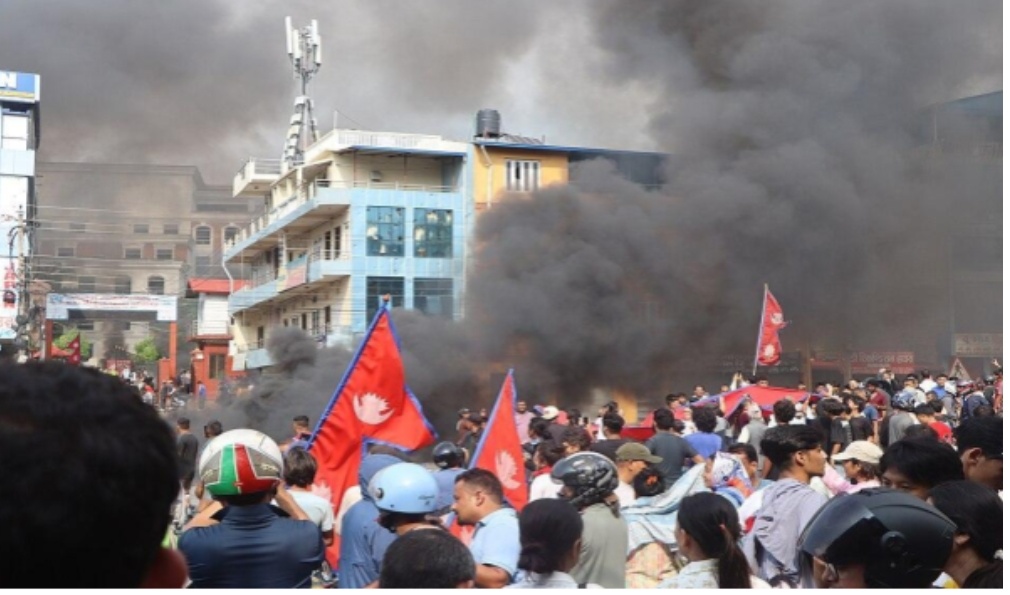
Nepal’s youth-led Gen Z movement began with a sudden and disruptive government decision to ban Facebook, YouTube, Instagram, X and other platforms because the companies failed to register with the state under new laws. The ban instantly cut off millions of people from their daily means of communication, work, education and family connections, causing deep frustration among the country’s young population. The anger was not just about the ban itself, but also a long-standing sense of corruption, nepotism and political instability – in a country that has seen 13 changes of government since 2008. The peaceful movement quickly turned into a violent national uprising; protesters set fire to the parliament building, the Supreme Court, the main administrative building and even the homes of five former prime ministers. The streets of Kathmandu fell silent under the curfew, and government buildings were reduced to rubble. At least 30 people were killed, including prisoners and some minors—a clear indication of the depth of the unrest. Demands for justice for the victims, state honor, and the abolition of parliament became central to the movement. Many youth leaders declared that they would not join any government, but would instead pledge to monitor democracy.
As chaos grew and political leadership virtually disappeared, Nepal's military was the only institution capable of stabilizing the situation. With government authority collapsing and the president in public absence, Army Chief General Ashok Nawrang appealed to the nation in a short video message. The military took control of Kathmandu overnight, and military officials engaged in direct talks with Gen Z leaders to peacefully resolve the situation. Retired Major General Binoj Basniat noted that the military was able to maintain public trust because it was committed to civilian authority and that the armed police, not the army, were firing. India, meanwhile, was closely monitoring the situation. The Armed Border Force increased border surveillance, and the Indian ambassador attended the swearing-in ceremony of the interim leader, albeit cautiously, given Nepal's history of anti-India sentiment.
One of the defining features of the movement was the digital transformation that followed the banning of social media. With mainstream platforms shut down, Nepal’s youth flocked to Discord, which had evolved from a gaming-based app into a new political arena. Within days, more than 145,000 members had gathered, where they debated national issues, held internal polls, and held “mini-elections” to elect an acceptable interim leader. Channel moderators noted that Discord did not represent the entire country, yet it had become the most active platform for political discussion. The prime minister quickly fell. After two days of violence and arson, KP Sharma Oli resigned, and ongoing talks between the military, youth leaders, and the president focused on finding a neutral and credible leader who could lead the country forward.
Ultimately, the youth leaders of Discord proposed former Chief Justice Sushila Karki as the interim prime minister. The army supported the decision and, despite initial hesitation, President Ram Chandra Paudel agreed to dissolve the House of Representatives and appoint her. Karki was sworn in as Nepal's first female prime minister. Her honesty, courage, and adherence to the Gandhian way of life established her as a credible leader in the eyes of the youth. She had previously studied political science at Banaras Hindu University, where she was known as a disciplined and focused student. Her former colleagues described her as someone who was committed to democracy and able to handle difficult responsibilities with great humility. However, some analysts warned that the decision to dissolve parliament could unintentionally strengthen pro-monarchist forces—given Nepal's history of past pro-monarchist movements.
This was also evident in the regional response. India prepared additional rescue flights to repatriate stranded Indian nationals due to the closure of Kathmandu airport, with fares kept reasonable and coordinated with the reopening of Tribhuvan International Airport. At the same time, border security in northern Indian states was tightened to ensure that no anti-social elements could exploit the instability to cross the border. The Telegraph reports that Nepal’s hotel industry has suffered huge losses—more than Rs 5 billion at the Hilton Hotel in Kathmandu alone, which was vandalized by protesters during the protests. Yet Gen Z leaders have repeatedly stressed that their movement has no links to pro-monarchy or mainstream political parties. They portray it as a purely civil movement and warn the old parties not to try to exploit the unrest for their own gain.
The events described in this report illustrate a profound and unprecedented generational shift in a society. A digital ban intended to control expression backfired and within days transformed into a massive, decentralized uprising that transformed the country’s political landscape. Institutions collapsed; new leadership emerged from unexpected quarters; the military stepped in to stabilize the situation with a delicate balance; and a youth-led online community began to lead the national political discourse. Whether this moment will mark the foundation of a genuine democratic renaissance or the beginning of further instability is yet to be determined; but the events documented in the media published report undoubtedly mark a historic shift in Nepal’s political trajectory—made possible by a generation that refused to remain silent.
Sayantan Banerjee is a Postgraduate in Political Science and International Relations from Jadavpur University. The views expressed in the above piece are personal and solely those of the author. They do not necessarily reflect the views of Kalinga Institute of Indo-Pacific Studies.

KIIPS is a premiere think-tank that intends to provide a platform to academics, researchers, scholars and experts from across the country and abroad.