
By Vaishnavi Mishra
Power in the international system is no longer measured solely by military capability or economic output. Joseph Nye's concept of soft power, the capacity to attract and persuade rather than coerce, captures a resource flowing from a nation's culture, values, and policies. Cultural diplomacy is the vehicle through which states convert these resources into geopolitical influence. Soft power's importance has grown sharply in the 21st century. Overt coercion carries steep costs amid nuclear deterrence and economic interdependence, while digital media lets cultural products cross borders instantly, reaching publics traditional diplomacy cannot. It is cumulative, building trust that pays off during crises; it embeds a nation's appeal in everyday foreign life outside formal government channels; and it is far cheaper than military instruments shaping whether a rising power is seen as threatening or benign.
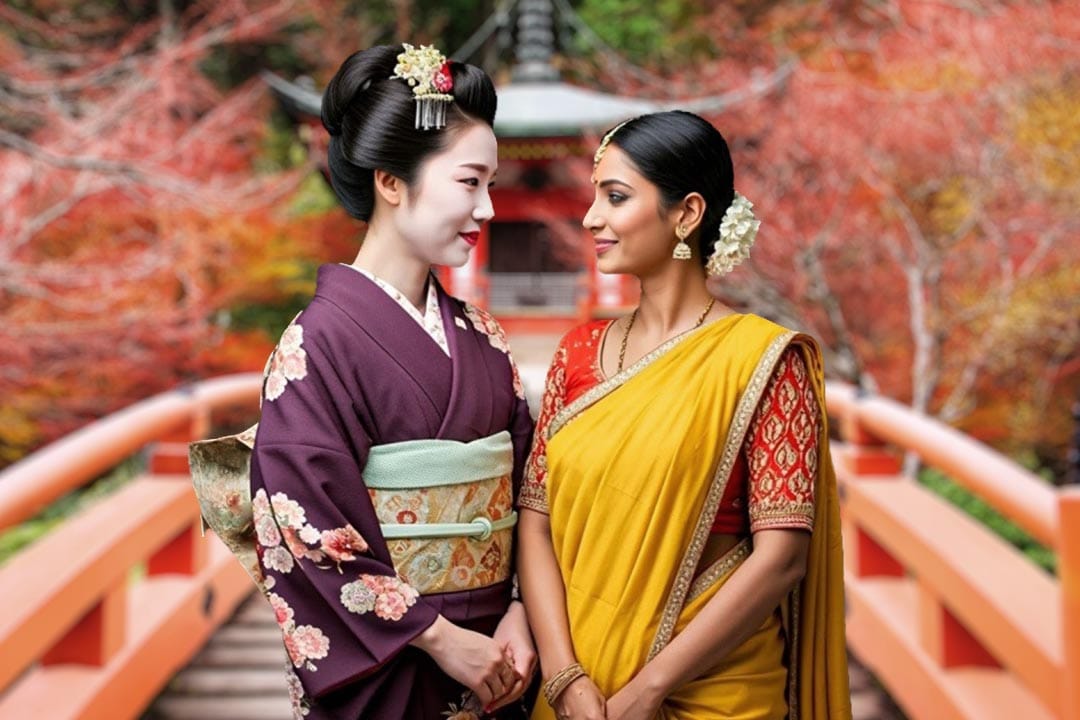
India and Japan, two of Asia's most consequential civilisational powers, illustrate this well. Their ties stretch back to the spread of Buddhism, which shaped Japanese art and philosophy, and have since been reinforced by democratic values and a shared stake in a rules-based Indo-Pacific, formalised through their 2014 Special Strategic and Global Partnership. This article compares their cultural diplomacy strategies, identifies India's shortfalls, and draws lessons from Japan's more refined model.
Japan's cultural diplomacy is widely regarded as among the world's most systematic, built on strong institutions, state-market collaboration, and global leverage of popular culture. The Japan Foundation, established in 1972 under the Ministry of Foreign Affairs, runs 26 overseas offices across 25 countries, delivering language education, arts exchange, and civil society programmes with consistency and professionalism rare among comparable institutions.
Japan's signature innovation is "Cool Japan" , the deliberate monetisation of pop culture as diplomacy. The government launched the Cool Japan Fund in 2013 as a public-private investment vehicle. Anime anchors this strategy, the industry generated $22 billion in 2023, a 14% rise on the previous year, while the global anime market valued at $28.5 billion in 2024 is projected to reach $42 billion by 2028. Rise in annual Anime events can be seen in Indian cities like Mumbai, Hyderabad, Bengaluru, Pune, Jaipur and many more.This is reinforced by commercial diplomacy, brands like Sony, Toyota, and Nintendo embed Japanese aesthetics worldwide. Digitally, active multilingual social media outreach and showcases like the Tokyo 2020 Olympics project Japan's blend of tradition and technological modernity.
India possesses extraordinary raw material for soft power: ancient philosophy, classical arts, a 35.4 million-strong global diaspora, and the world's largest film output. Its challenge has been converting this richness into coherent strategy. The Indian Council for Cultural Relations (ICCR), founded in 1950, anchors India's institutional effort, expanding its Cultural Centres across Asia, Africa, Europe, and the Americas under the Modi government's more active foreign policy.
India's standout success is yoga diplomacy. India's UN proposal led to the International Day of Yoga in 2014, co-sponsored by a record 177 countries. The inaugural 2015 New Delhi event set Guinness records for the largest yoga session which included 35,985 participants and 84 nationalities in one session, and embassy-led yoga events are now annual fixtures worldwide, a low-cost and universally accessible marker of Indian civilisational identity.
Bollywood has long functioned as informal soft power, commanding audiences across Central Asia, the Middle East, and Africa. Indian cinema's box office sales crossed $1.48 billion in 2025. Yet unlike Cool Japan, this reach remains organic and uncoordinated, with no systematic state framework behind it.
India's diaspora is 35.4 million strong, the world's largest is arguably its most underused asset. Indians are the largest migrant group in Canada and second-largest in the US, India received roughly $135.4 billion in remittances in 2025. As the US approaches its 250th anniversary in 2026, another trend marks its recent economic story: the rise of Indian-origin executives leading major American corporations. Over the past two decades, leaders born or educated in India have taken charge of top firms spanning technology, cloud computing, payments, cybersecurity, semiconductors, and pharmaceuticals. This shift has unfolded alongside major global economic changes from the growth of cloud computing and AI to advances in digital payments, cybersecurity, and healthcare technology. Programmes like Pravasi Bharatiya Divas engage this network, but only episodically.
India's shortfalls relative to Japan are instructive. First, an institutionalisation deficit ICCR remains underfunded compared to the Japan Foundation's office network and sustained state backing. Second, in the absence of a coherent "Brand India", Japan's Cool Japan succeeded through a deliberate, government-backed narrative; India has not unified its comparable assets into one national brand. Third, underutilised popular culture, Bollywood's global reach lacks the institutional linkages akin to the Cool Japan Fund needed to convert audiences into diplomatic capital. Fourth, a digital lag India has been slower than Japan to deploy social media, streaming, and data-driven targeting as diplomatic tools.
India and Japan share civilisational depth and a stake in a stable, multipolar Asia, but Japan's cultural diplomacy is more institutionalised, better funded, and more coherent. India already holds the assets of a vast diaspora, an unmatched film industry, yoga's global footprint, and democratic appeal. The task is building the architecture to deploy them. As Nye reminds us, soft power must be cultivated, not assumed. Japan's disciplined model of institutional depth, public-private investment, and cultural leverage offers India a valuable diplomatic blueprint.
Vaishnavi Mishra is postgraduate in Political Science from Kanoria PG Mahila Mahavidhyalaya, Jaipur, University of Rajasthan. The views expressed in the above piece are personal and solely those of the author. They do not necessarily reflect the views of Kalinga Institute of Indo-Pacific Studies.

KIIPS is a premiere think-tank that intends to provide a platform to academics, researchers, scholars and experts from across the country and abroad.