
By Kumar Saurabh
The 2026 Iran-Israel conflict, involving the United States, shifted global attention to the Strait of Hormuz. As military tensions escalated, Iran imposed restrictions on shipping through this narrow waterway. This immediately triggered a rise in oil prices, higher shipping insurance costs, and increased concerns regarding global supply chains. Although the crises began in West Asia, their consequences can be seen beyond the region. It was a reminder that any disruption in critical maritime lanes can make the global economy vulnerable.
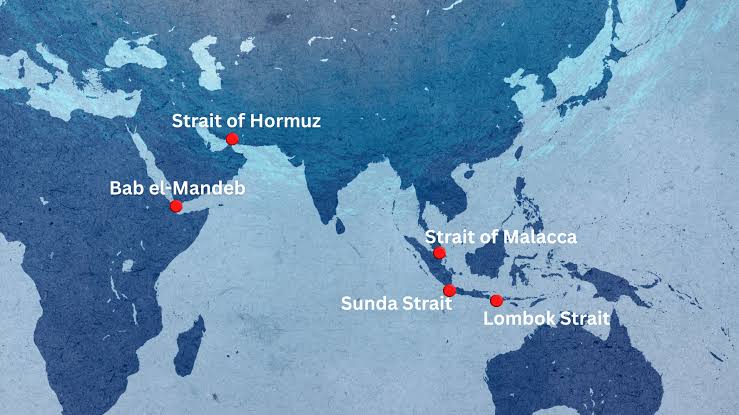
The events occurring in the Gulf also highlighted the strategic importance of securing maritime trade routes in the Indo-Pacific. This brought another equally significant chokepoint, the Malacca Strait, to the forefront.
The Strait of Hormuz, located between Iran and Oman, is one of the most crucial energy corridors in the world. Estimates suggest that nearly one-fifth of the global oil consumption and a significant amount of liquefied natural gas pass through it every day. Any disruption affects international energy markets. The current crises show that maritime routes are the strategic lifelines that connect producers, consumers, and global industries.
Similarly, the Malacca Strait links the Indian and Pacific Oceans between Indonesia’s Sumatra Island and the Malay Peninsula. It is one of the busiest Sea Lines of Communication (SLOCs) as it facilitates the movement of a considerable share of global trade, including energy supplies, manufactured goods, and industrial raw materials. Countries such as China, Japan, South Korea, Singapore, and India are widely dependent on the Malacca Strait for their economic growth and energy security.
If Hormuz is the world’s energy gateway, Malacca is the delivery route. The energy supplies that pass through Hormuz reach Indo-Pacific countries through the Malacca Strait. Both chokepoints are not isolated but linked to each other. As disruption in one place creates immediate pressure on the other.
In the case of China, its dependence on the Malacca has been viewed as a strategic vulnerability, described as “Malacca Dilemma.” Chinese policymakers have always shown concerns over this dependency and have focused on diversifying their transport and energy routes through the Belt and Road Initiative. Although Beijing has invested in Gwadar Port and energy pipelines through Myanmar, these alternatives cannot reduce the importance of Malacca, as its geographical location makes it crucial for China.
India has a different strategic viewpoint for Malacca. The Andaman and Nicobar Islands, located near the western entrance of the strait, strengthen India’s position in maritime domain awareness and increase its ability to monitor shipping lanes across the eastern Indian Ocean. The security of the Malacca Strait closely aligns with India’s Act East Policy and its broader vision of a secure, open, and inclusive maritime order in the Indo-Pacific.
However, the challenges in the Malacca Strait extend beyond geopolitical rivalry. These include several non-traditional security threats, such as piracy, illegal fishing, maritime terrorism, cyberattacks on port infrastructure, and environmental accidents, causing severe economic consequences. This indicates that maritime security today is not limited to naval competition but also requires resilience against emerging non-conventional threats. Therefore, regional cooperation remains indispensable. Indonesia, Malaysia, and Singapore are implementing coordinated initiatives, such as the Malacca Strait Patrols. While ASEAN promotes dialogue, confidence building, and practical cooperation. Simultaneously, India, Japan, Australia, and the United States can contribute through information sharing, capacity building, maritime domain awareness, and humanitarian assistance.
The 2026 crisis is not only a regional conflict but also a strategic warning. This demonstrates that even local tensions can escalate and lead to the disruption of global commerce. Maritime, energy, and economic security are deeply connected. Therefore, the Malacca Strait must remain secure, open, and stable to ensure an uninterrupted flow of trade, energy, and economic prosperity across Asia and the larger Indo-Pacific.
As strategic competition increases and supply chains become more interconnected, maritime chokepoints will continue to play an important role in ensuring regional security. There is a need to keep the Malacca Strait secure, open, and governed by international law in the interest of all stakeholders. The future of the Indo-Pacific is not dependent only on economic and military partnerships but also on collective efforts to protect the sea lanes.
Kumar Saurabh is a PhD Scholar, University Department of Political Science, Ranchi University, Ranchi, Jharkhand, ICSSR Full-Term Doctoral Fellow. The views expressed in the above piece are personal and solely those of the author. They do not necessarily reflect the views of Kalinga Institute of Indo-Pacific Studies.

KIIPS is a premiere think-tank that intends to provide a platform to academics, researchers, scholars and experts from across the country and abroad.