
By Amreen Ayaz
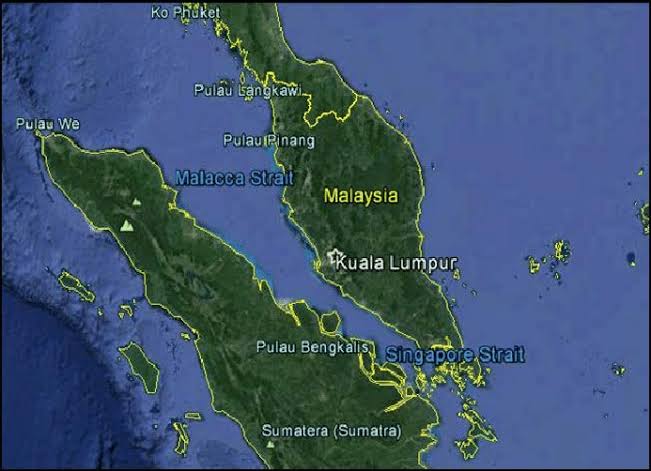
Maritime chokepoints are naturally formed passageways in the sea through which trade passes from the producing nations to the buyer nations. The Strait of Malacca is one such point connecting the Andaman Sea in the Indian Ocean with the South China Sea in the Pacific Ocean. Its narrowest point lies at the Phillips Channel in the Singapore Strait. Heavy trade, which has historically attracted settlements around routes, the development of technology, and conflict over resources, makes these natural passageways strategically important. However, their significance is not limited to trade but stretches far beyond that to other dimensions.
These maritime passageways have the power to increase or decrease the value of treaties and agreements between nations as they cut the time and costs of travel. Moreover, the Malacca Strait is a geopolitically critical point and at the same time a biodiversity hotspot with the presence of the ‘Sunda Hotspot.’ Connecting continents, Americas, Europe and Asia through commercial activities these straits serve as a bridge that facilitate cost effective and time-saving movement of goods. They are also the pulse of diplomacy in this area; any pressure on the straits sends ripples through the relations between nations.
Malacca Dilemma and the Role of the United States
The 7th and 5th Fleets of the U.S. Navy operate in the Indo-Pacific and the Middle East. Both areas have historically been the centre of world politics, and the U.S. has maintained its hegemonic status by situating itself in these regions with the help of its military might. It is also the only force currently capable of ensuring the security of these sea routes, leaving little choice for the other great and middle powers. However, as China became the greatest beneficiary of this security, which also helped it modernise its economy, it now faces a challenge due to geopolitical stress and trade tensions.
The term ‘Malacca Dilemma’ stems from the dependence of Chinese trade and energy security on the Malacca Strait. It was coined by the Chinese President in 2003, and it relates to the dependence of the Chinese economy on these sea lines of communication. There is a dilemma because the Chinese are vulnerable to a naval blockade, which can happen due to the increasing rivalry between China and the US in the region. China is actively exploring alternatives to diversify its trade and energy supply routes.
Piracy and Ecological Disaster
The straits are not only a biodiversity hotspot, but also a piracy hotspot. This is a natural outcome given the high amount of trade in the region, the lack of consensus on security providers, and the increasing conflict of interests between the countries. The efforts of the Malaysian, Indonesian, and Singaporean navies since the year 2004 have brought down piracy to a private commercial enterprise. Ecologically, there are two sides: first, the ships are being affected by the environment, and second, the ecology is being harmed by the traffic. The yearly bushfires of Sumatra affect passing ships by reducing visibility, making the path dangerous. On the other hand, the high amount of pollution due to the navigating vessels destroys the fragile ecology of the bordering states. The traffic causes oil spills and discharges ballast water, sewage, and other solid wastes. In the end, the negative aftereffects of the trade are left to be dealt with by the littoral states.
Security Providers: India and the Malacca Strait Patrol
India benefits from its location in the Indian Ocean, as it has strategic access to the Malacca Strait as well as the Hormuz Strait, the latter situated between the Persian Gulf and the Gulf of Oman. The peninsular nation has proposed to join the Malacca Strait Patrol — “a set of practical co-operative measures undertaken by Indonesia, Malaysia, Singapore, and Thailand.” It was an effort by India to realise its vision of a “free, open, inclusive region, which embraces … all in a common pursuit of progress and prosperity.” However, the developments on India’s proposal have been minimal, which signals the sensitivities of the Southeast Asian nations on India’s role as a regional security provider. Nevertheless, cooperation of the Southeast Asian countries remains indispensable for India, a fact underscored by the very designation of the region’s main shipping route as the Strait of Malacca and Singapore (SOMS).
In conclusion, the Malacca Strait is one of the most significant maritime routes supporting the economy and influencing the politics of the world. With about 60% of the global maritime trade passing through the region, the Strait has become an essential geopolitical focus for not only the states surrounding it but also extra-regional countries, including the U.S. and the European Union. Therefore, the security management, the treaties and agreements, and the ecological safety of the Malacca Strait become the responsibility of every actor reliant on it for economic development. To balance the equation of “great power rivalries,” the European Union has devised a “third way” between China and the U.S, called the “European view of the Indo-Pacific.” Whichever path is taken, the growing pressures on the Strait suggest that its future can be secured through cooperation rather than conflict.
Amreen Ayaz is a PhD Scholar at University of Aberdeen. The views expressed in the above piece are personal and solely those of the author. They do not necessarily reflect the views of Kalinga Institute of Indo-Pacific Studies.

KIIPS is a premiere think-tank that intends to provide a platform to academics, researchers, scholars and experts from across the country and abroad.