
By Srishtistuti Roy
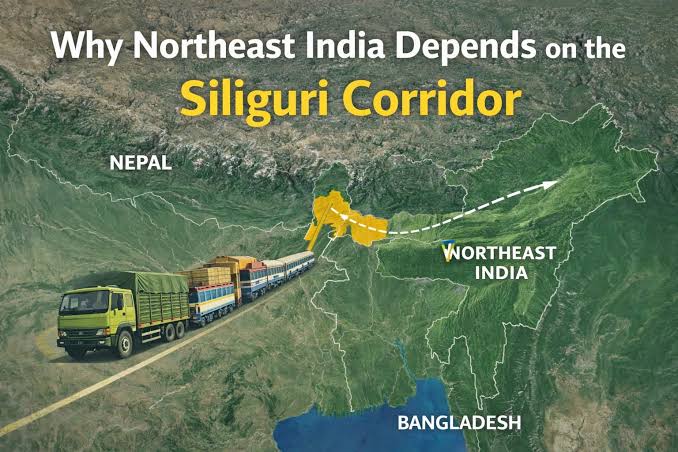
The Siliguri Corridor in West Bengal, India is a sliver of land, barely 22 kms wide at its narrowest stretch, boxed in by Nepal to the west, Bhutan to the north, Bangladesh to the south and the Chumbi valley to the northeast. Owing to its vulnerable geostrategic location as the sole land link between the Indian mainland and the Northeast of India, it is often described by the anatomical metaphor of the ‘Chicken’s Neck’ in military parlance. So far, the Corridor has not featured in Indo-Pacific scholarship because the framework refers to the maritime zone extending from the eastern coast in Africa to the western coasts of the Americas, between the Suez Canal and the Strait of Malacca. Yet, the Corridor is situated at a point where India’s continental anxieties clash with its maritime ambitions. Therefore, to gain deeper insight into how India operationalises the concept of the Indo-Pacific, a critical examination of the Corridor as a terrestrial chokepoint as well as a pivot of the Act East Policy is necessary.

Map showing the Siliguri Corridor’s location within the Indo-Pacific Region (Roy 2026)
Continental Instinct, Maritime Ambitions
India’s strategic thinking is primarily shaped by its land borders. Since the diplomatic spat with Bangladesh in 2025, the renewed preoccupation with militarily fortifying the Siliguri Corridor has only reinforced this characteristic. The Partition in 1947 connected the northeastern region with a fractured Bengal through the Corridor, much like an isthmus, which has ever since been a major security as well as developmental challenge for the state. The 1962 Indo-China war entrenched a Himalayan threat perception that still animates the country’s defence planning. The 1971 Indo-Pakistan war created Bangladesh, a neighbour with whom bilateral relations play a crucial role in managing borders, especially along the Corridor. Coupled with this, unresolved border issues with both Pakistan and China continue to take up a disproportionate share of India's military attention and infrastructural expenses. Although New Delhi has adopted the maritime vocabulary of the Indo-Pacific, anchored in concepts such as SAGAR and partnerships like the QUAD, its underlying strategic posture remains substantially continental. India’s maritime ambition of being a net-security provider in the Indo-Pacific, ensuring a free, open and inclusive region rests on its ability to physically connect its mainland to Southeast Asia and that connection has few maritime substitutes. Every road, rail link and pipeline meant to connect India to Myanmar, Thailand, the broader Mekong region and eventually to ASEAN countries must first pass through the Siliguri Corridor. In this sense, the Corridor functions as a terrestrial chokepoint inside a maritime security architecture, comparable in logic to the way the Strait of Malacca constrains sea traffic. Disrupt the Corridor and India’s overland Act East ambitions collapse regardless of how many warships it can field in the Bay of Bengal. Its vulnerability is further compounded by China’s infrastructure buildup near Doklam and porous borders with Bangladesh.
Building Redundancy Through Diversification
Recognising this fragility, India has adopted a deliberate strategy of diversification rather than solely relying on fortifying the Corridor. The Kaladan Multi-Modal Transit Transport Project links Indian ports to Myanmar’s Sittwe port and onward via the Kaladan river to Mizoram, offering a riverine bypass of the Corridor altogether. The India-Myanmar-Thailand Trilater Highway, intended to connect Manipur to Thailand via Mandalay, remains the flagship overland route to ASEAN, though conflict in Myanmar since the 2021 coup has pushed its completion towards 2027. Closer home, the recently sanctioned Agartala-Akhaura rail link and a growing network of transit routes through Bangladesh;s Chittagong and Mongla ports anchored by the Maitri Setu bridge near Sabroom give Tripura and the wider northeast region a far shorter route to the sea than the roughly 1600km detour through Kolkata. Inland waterway protocols with Bangladesh, the Jal Marg Vikas project on the Brahmaputra and Ganga systems, and a newly announced underground rail link project through Siliguri all aim towards reducing single-point dependence without abandoning the Corridor that remains, for now, indispensable to India’s strategic interests.
These projects are not isolated infrastructure schemes. They provide the continental scaffolding of the Act East Policy, which hinges upon connectivity, commerce, and cultural ties with Southeast and East Asia. The policy explicitly designates the Northeast neither as a frontier to be defended nor as a logistical bottleneck to be managed but rather, as a gateway to be built and proactively secured. It is in this context precisely that the Siliguri Corridor assumes strategic significance as the pivot through which the policy is operationalised. Greater securitisation and economic transformation of the Corridor inches the policy closer to success; conversely, building redundancy through diversification of land and maritime routes while neglecting the Corridor’s development will weaken not only the fulfilment of the Act East’s goals but also India’s maritime security architecture. Thus, the Siliguri Corridor’s significance within the Indo-Pacific framework might bear a paradoxical impression. Yet, it is an accurate reflection of India’s geographical realities and an assessment of India’s regional ambitions should start here.
Srishtistuti Roy is a student of MA, Political Science. University of North Bengal, Siliguri. The views expressed in the above piece are personal and solely those of the author. They do not necessarily reflect the views of Kalinga Institute of Indo-Pacific Studies.

KIIPS is a premiere think-tank that intends to provide a platform to academics, researchers, scholars and experts from across the country and abroad.