
By Puloma Pal
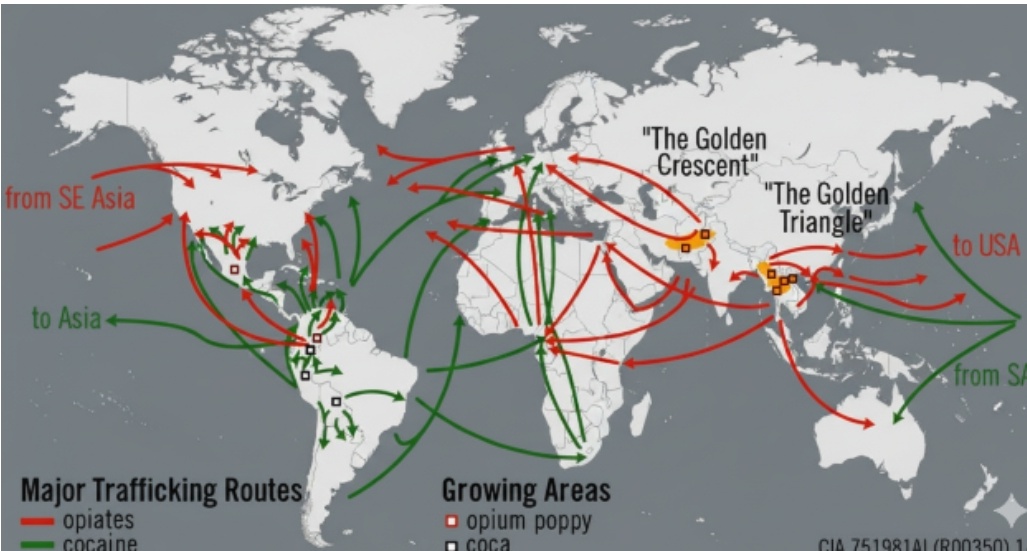
The Indo-Pacific region faces a significant security threat from the intersection of narcotics trafficking and violent extremism, termed as narco terrorism. Current studies and analysis focus largely on great power competition and territorial disputes, while sub-state networks exploit illicit economies to geopolitical objectives, undermining state sovereignty. Around 80% of the world’s heroin supply comes from Afghanistan, providing $100 million to $400 million annually to terrorist groups like the Taliban and Al Qaeda. Meanwhile, the Golden Triangle of drugs trafficking in the Indo-Pacific region evolved into a global hub for chemical narcotics like Methamphetamine, generating profits of over $40 billion annually, which finances Ethnic Armed Organizations like United Wa State Army, Karen National Union and Kachin Independence Army and transnational crime syndicates across Southeast Asia. These narcotics revenues are estimated to generate $100 billion annually, supporting insurgency, corrupting state infrastructures, leading to the creation of drug corridors in the Andaman Sea and the Bay of Bengal. The historical involvement of Pakistan’s ISI in narcotics flows sustains low intensity warfare in South Asia. The existing regional security strategies, focused on traditional threats, are inadequate, necessitating a shift in policy to recognize narco financing as a primary geopolitical threat rather than a secondary criminal issue.
Crime Terror Nexus in Indo Pacific
The rapid growth of Narco terrorism in the Indo-Pacific region represents a significant failure of the current geopolitical security paradigm, necessitating an immediate policy recalibration. This issue extends beyond mere criminal activity to a fully integrated alternative political economy that finances insurgencies and undermines state authority from South Asia to the Golden Triangle. Afghanistan epitomizes this situation, with the Taliban deriving around $400 million annually from the opiate trade, which is essential for their governance and control. The rapid growth of Narco terrorism in Indo Indo-Pacific region represents a significant failure of the current geopolitical security paradigm. Hence, it demands an immediate policy recalibration. It directly contests state authority from South Asia to the Golden Triangle. Concurrently, Southeast Asia faces a synthetic drugs crisis, particularly the Shan state of Myanmar is the root of considerable destabilization. The Golden Triangle actors, primarily in the Shan state of Myanmar, where methamphetamine production is surging, empower non-starter actors like the United Wa State Army and the Arakan Army. Moreover, the maritime drug smuggling routes in Arabian Sea are actively exploited by the Islamist terror groups that fund attacks in India. Without addressing these complex challenges, the Indo-Pacific will continue to remain a battleground of persistent sub-state warfare.
State Weakness and Political Collusion
The Narco Terrorism networks of Indo Indo-Pacific region stem from governance failure and state collusion rather than just porous borders. A military coup in Myanmar in 2021 perpetuated the drug trade, with a notable increase in synthetic drugs, 190 tons of meth seized in production in Shan State in 2023. Meth prices in the production area are low, indicating a strong supply chain involving both state and the criminal elements. The Taliban’s opium prohibition countered by stockpiles led to increasing value, with dry opium prices reaching $730 per kilogram by mid-2024. In Pakistan’s Baluchistan region, drug smuggling routes serve not only organized crime but also the state and non-state actors, contributing to domestic instability and regional insecurity, emphasizing the crucial role of state-affiliated ownership in these operations.
Maritime Drug Corridor and Cartel Expansion
The illicit drug trade is facilitted by transnational organized crime group, militant proxies and maritime smuggling networks. After the Taliban’s opium ban, Myanmar has become the leading opium source, with cultivation in terms of area reaching approximately 45,200 hectare in 2024, leading to record chemical drug production, particularly methamphetamine. The Indian Navy and the Coast Guard have intercepted significant heroin and synthetic drug shipment from Golden Triangle and the Arabian Sea, particularly during Sagar Manthan – 1 operating, where 3,300 kg of drugs of drugs were seized. These illicit operation are often associated with criminal syndicates linked to terrorist organizations like Lashkar-e- Taiba and Jaish-e-Mohammed, who utilize deep sea fishing boats and cargo ships for trafficking.
Strategic Implications and Geopolitical Vulnerability for India
The proliferation of Narco weaponization in the Indian Ocean Region (IOR), presents a serious threat to India’s internal and external security. Drug-profit function as a considerable source for extremist groups. These groups may consist LeT, JeM and ISKP to finance infiltration and procure weapons and sustain radicalization. The Narco trade fuels internal instability in addition to radicalization through addiction, corruption and money laundering. Thereby weakening the integrity of domestic finances. Narco networks capitalize on weaknesses generated in littoral states through governance failures and political instability. This further leads to strategic risks at India’s own maritime frontiers. The current regional counter-narcotics efforts by SAARC drug offences monitoring desk and UNODC, is reactive, and lacks coordination. Hence, this poses a significant risks for QUAD nations as well. Without a cohesive, multi-agency maritime narcotics strategy, the Indo-Pacific could become a chronic battleground.
The Bottom Line
Narco Terrorism poses a structural risk in Indo-Pacific region. Drug cartels, insurgent organizations, and extremists are creating collaborative networks that exploit porous borders, unregulated maritime spaces, and political disorganization. The nexus of crime and conflict weakens state institutions, accelerates societal violence, and disrupts maritime trade routes. India and its partners should approach narco terrorism as hybrid warfare, implementing strategies like maritime intelligence fusion and financial disruption to address this significant regional threat.
***Puloma Pal is a PhD scholar at Amity University, Haryana. The views expressed in the above piece are personal and solely those of the author. They do not necessarily reflect the views of Kalinga Institute of Indo-Pacific Studies.

KIIPS is a premiere think-tank that intends to provide a platform to academics, researchers, scholars and experts from across the country and abroad.